INTERVIEW: Grant Faulkner (Something out there in the distance)
Something out there in the distance
Grant Faulkner
Photos by Gail Butensky
University of New Mexico Press
A conversation with
Amy Brinker
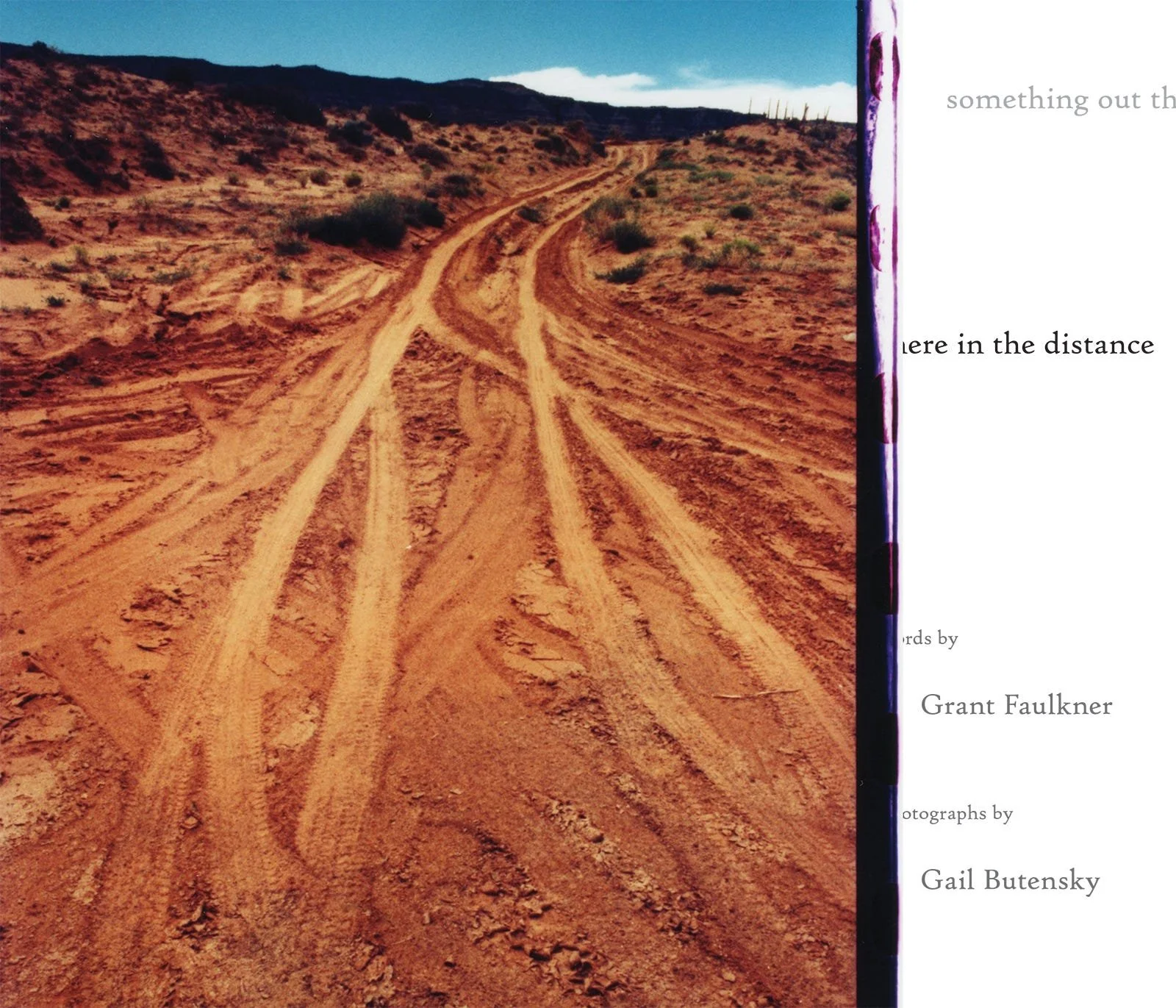
Grant Faulkner's newest book brought me right back to childhood summers visiting family in rural New Mexico, driving hours and hours to get anywhere. As a city kid, I was struck by the sheer expanse, the road disappearing into a perspective dot on the horizon. The emptiness could be overwhelming. Something out there in the distance is a flash fiction novel that follows Dawn and Jonny on a restless Southwest roadtrip; they live as intensely as they can, eating up miles of highway and trying to speed away from Dawn's illness.
Despite his love for long, solo roadtrips, Grant has become a writer who loves to collaborate with other artists. Photos from his longtime friend Gail Butensky add to the book's frenetic energy and make this project especially meaningful.
In this interview, we chatted about creative collaboration, fostering an unshakable belief in yourself as a writer, and the appeal of flash fiction.
The article has been edited for length and clarity.
Amy Brinker: To me, road trips are so physical; your body is cramped, it's hot, you can feel wind on your face. Could you explore some of the sensory details you wanted to capture?
Grant Faulkner: That's great that you're bringing it into the sensory feelings because that is so much about what a road trip is like. From the potato chips in your car to the dust all around you on the road, to (especially if you're driving with a crappy air conditioner) the feeling of sweating.
And, you're cramped in this car and yet you're part of the expanse of the world at the same time, So there are these interesting kinds of tensions.
AB: Was there a particular Southwestern road trip that made you want to write about it?
Grant Faulkner: Not one in particular. My introduction to the Southwest came from my now- wife, Heather. I would've been like, I don't know, 27, and we drove from San Francisco to Tucson, Arizona, to have Thanksgiving with her family. I was just so enchanted and entranced by that first drive there and the way the whole world just changed.
The landscape changed, but also just the people, the feel of everything. You can still legitimately drop out in the Southwest and in Arizona, and there are a lot of dropouts, and some of them are beautiful, wonderful artists, and some of them are really menacing, dangerous people.
The whole Wild West thing is still very present, very tangible, and very much handed down from generation to generation. You have to stay there for a while to realize how deeply it's in people's genes, at least the people who've been there for generations.
So I'll never turn down an opportunity to take a Southwestern road trip. I actually prefer to go alone these days, like the more godforsaken, the better for me. I get so mesmerized by the highways that I've actually almost ran out of gas a couple times in very barren places. Once I was driving at sunset, and I hadn't seen a car for so long, so I literally just stopped my car on the road, got a beer out, and sat on the hood and watched the sunset. It was just one of those beautiful moments where you own the world.
AB: There's a real recklessness throughout this book. Do you have a sense of how Dawn and Johnny met? I'm thinking of their wild connection and wondering how they first got together.
GF: I've never been too into character background, I really write intuitively. And, they came about accidentally because Gail, my friend who took all the photos, gave me about 40 of them, and I had no plan for the book.
I didn't have characters in mind. The only plan was actually that I was gonna write individual small, tiny stories for each photo. But then when I got into it, I was like, "No, I want a narrative. I want these to be linked stories and the photos to be linked and it to feel more like a novel."
One photo just sparked: lovers driving across the Southwest. I can write about that forever. Dawn was obviously the kind of bigger, more vivid, more powerful character in a lot of ways, but I loved Johnny as someone who's lost himself and deeply in service to Dawn.
AB: With a character like this choosing to die on her own terms, there's a real moral gray area for her partner...like what is the right thing to do? That ambivalence came through really strongly.
GF: Thank you for saying that, because that's the Wild West kind of heritage being very present. It becomes lawless. You're out there driving the highways and you don't feel like there's any law looking over your shoulder. It invites this breaking of the rules or making new rules, I think. You're really in an in-between space; it feels very unsettled.
AB: I was interested to hear that Gail's photos came before the writing. How did this book come to be?
GF: Gail and I waited tables way back in the early '90s together, in San Francisco. And, I just loved her...back then, she mainly took punk rock photos and she could capture that raw energy in just really amazing ways. But then she got really into road trips, and she would go camping and capture the Southwest in ways I hadn't really seen before.
Initially, I had blurbed a book that she did for this small press, and the editor at the press said, "Hey, you should write 100-word stories to her photos." And so the idea came from him. I've always been interested in the intersection between stories and photos, and I just love Gail's photos, so I didn't think twice. I wish every project could be like this. It was the most effortless, joyful writing experience I've ever had.
AB: Did you wait to show her what you were writing until the very end, or did you give her peeks?
GF: Pretty much at the very end. And she liked it, I guess you share a draft, you never know. But I feel like Gail and I have such a history and such a trust that I wasn't really expecting her not to like it.
She said one funny thing. She's like, " There's a lot of God in here." I don't know if that was purposeful. I think it was more intuitive, and it just happened. I'm very influenced by Denis Johnson, and I always thought what was wonderful about his work was that he was able to write about extremely God-forsaken people who were also in touch with something holy.
I love that intersection: that pain can hold beauty or that there is beauty in pain. The way I like to think of this sometimes is that the most down-and-out characters can hold this strange, holy beauty.
AB: So many people connect with their spiritual side when they're dying, when they're close to death. I was interested in Dawn's attitude towards God, could you speak to her relationship with religion?
GF: Yeah, I grew up in a small town in Iowa and I think probably the worst thing you could be was a preacher's daughter. There was just so much pressure on them. Almost all the ones I knew rebelled in really extreme ways. So I've always been intrigued by the character of a preacher's daughter and how they can carve out an identity. They're born into the church, it's part of their whole life from the beginning, and there's this heavy expectation to be a good Christian, a good person.
In some ways, you have to be a sinner too, to make yourself whole. In terms of Dawn, I viewed her as unreconciled with her parents. She loved making fun of God and the Bible and diminishing religion in a way. But at the same time she revered it, and it was deeply a part of her. I always remember Jean-Paul Sartre said that if you've ever believed in God, you never can quite ever truly disbelieve.
That's the way it's been in my life, too. It's strange to me that I pray to a God that I do not believe in at all and I find solace and hope in it.
AB: Lots of writers depend heavily on writing rituals. Do you stick to any routines or a particular space?
GF: My rituals aren't very elaborate. I used to go to cafes and write all the time, and I don't even do that. Now I work on a laptop in a recliner. When I was, I don't know, six or seven years old, my mom got me this tiny roll-top desk for a kid that I just coveted. I also, for some reason, coveted finding little talismans to put on it...I was very into decorating my desk.
AB: I love that. That's very crow-like, just collecting shiny things. It reminds me of Dawn in your book, beautifying everything with glitter throughout the story.
GF: Yeah I actually know somebody who decorates every hotel room she's in, and I admire it, you know?
AB: Ha, like, All Fours, basically.
GF: Yeah. How funny you mentioned that, because I read All Fours on a road trip. I was driving back and it was just getting dark. I had about four hours to go, and normally I could just push through it and get home, but I hadn't read the last like 50 pages or so of All Fours.
So I stopped at this Motel 6 in Lost Hills, California, and there was a food truck there, and I got a great Mexican dinner, and sat in the hotel room and finished it. And it was just the most beautiful way to finish that novel. It's one of my favorite reading experiences.
AB: A really major part of your ethos seems to be collaboration, encouragement, and community in writing and artistic pursuits. With your podcast, your Substack, and all these different ways you connect with readers and writers, is there something you feel like you repeat over and over? Do you have a message you're trying to get across to people?
GF: I essentially repeat, like, five things. I repeat them because they are kind of my commandments and my ethos. The number one thing is that your story matters. Those are the three most important words in any writer's life because you have to believe your story matters, from start to finish, you know? You wouldn't actually put the first words down if it didn't matter. You wouldn't get through the horrible, muddy middle. You wouldn't finish it. All those things take such commitment and such endurance and such a battle with yourself.
So that belief gets you through the writing process, and also the process of getting it published. You've got to constantly nourish your belief in yourself as a writer and your belief in your story.
AB: You've done a lot of writing about imposter syndrome.What builds that foundation of being able to believe in yourself?
GF: When I started writing, I had a healthy dose of naivety and ignorance and delusions of grandeur. Even though I've had plenty of doubt and plenty of insecurity and plenty of imposter syndrome, I've also had this deep belief that I never really wavered, that I could become a good writer. No one was encouraging me to be a writer. The thing is, I believed that I could work hard enough to be a good writer, and that's basically what I believe in, for most people.
I always hate when people diminish themselves or say they don't have any talent or whatever. That's why those three words, 'my story matters', matter so much. They let you say, "Well, I might not be as talented as I want to be now, but I can get there."
AB: In a couple interviews you mention that you like the muddy middle space that flash fiction occupies. Did this longform flash project feel different to you?
GF: I always call myself a frustrated poet who's trapped in a prose writer's body. I very much gravitate towards lyricism and music and mood, all those more poetic elements to carry the story. Writing with more of a flash aesthetic relieves me of the burden of plot.
The brevity lets you enter the mundane a little more... or the drama of the mundane. These little stories with the photos, I think they were each kind of a moment of intensity, a memorable moment. You go on a road trip, and it's not necessarily the big story arc that you remember. It's all these little moments, the little things.