INTERVIEW: Lauren C. Johnson (The West Façade)
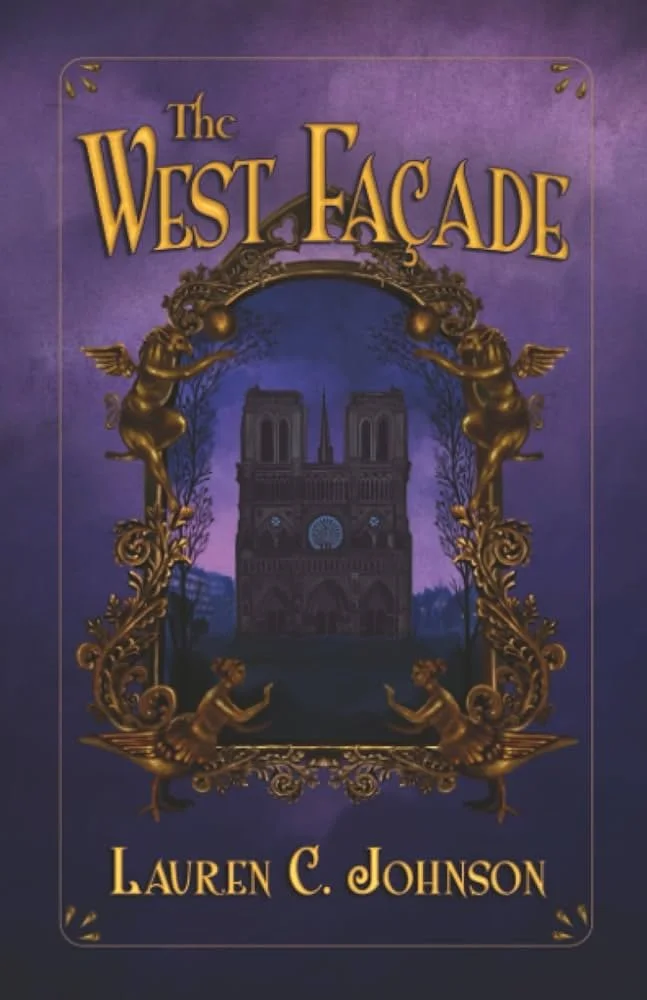
The West Façade
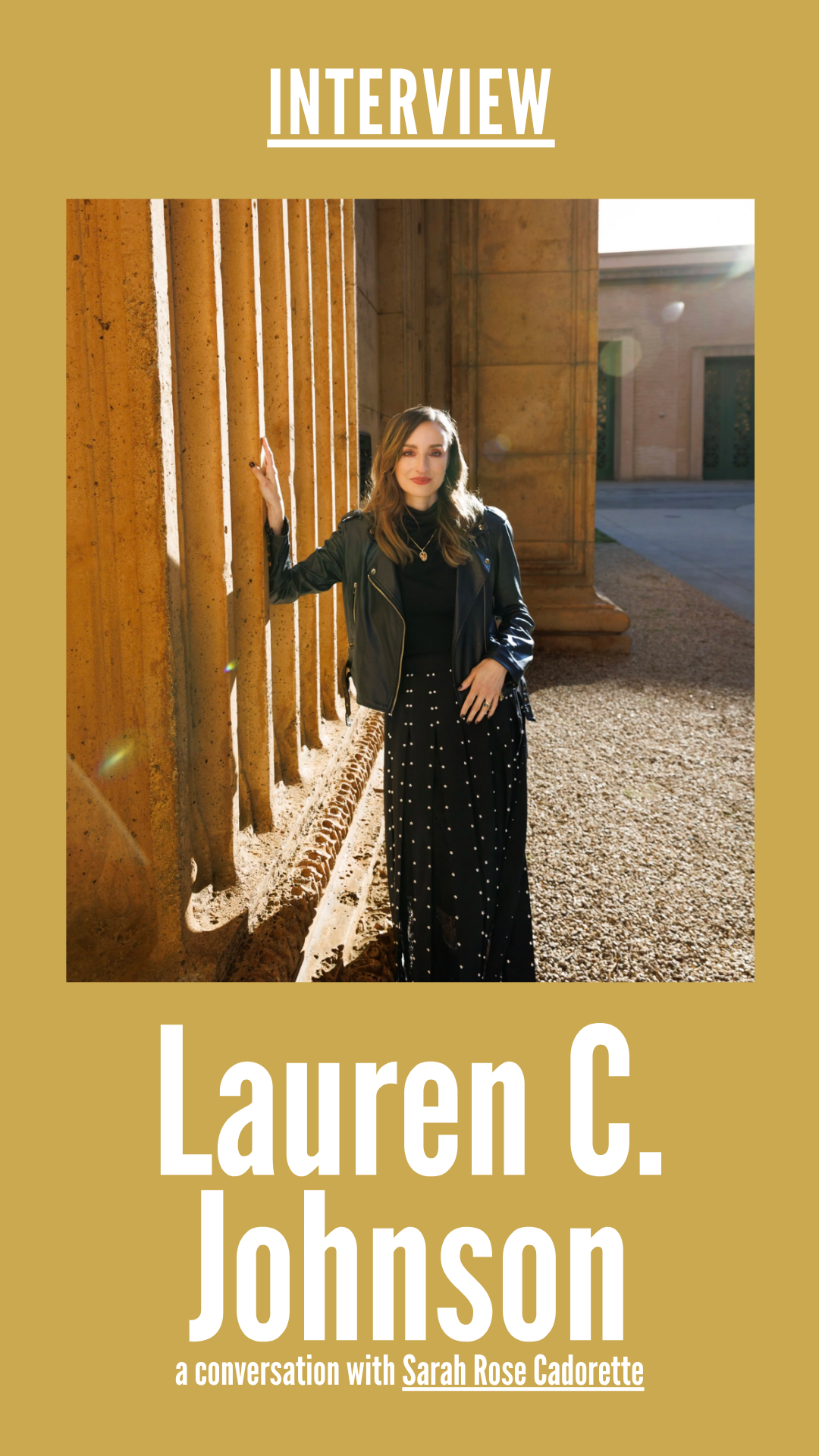
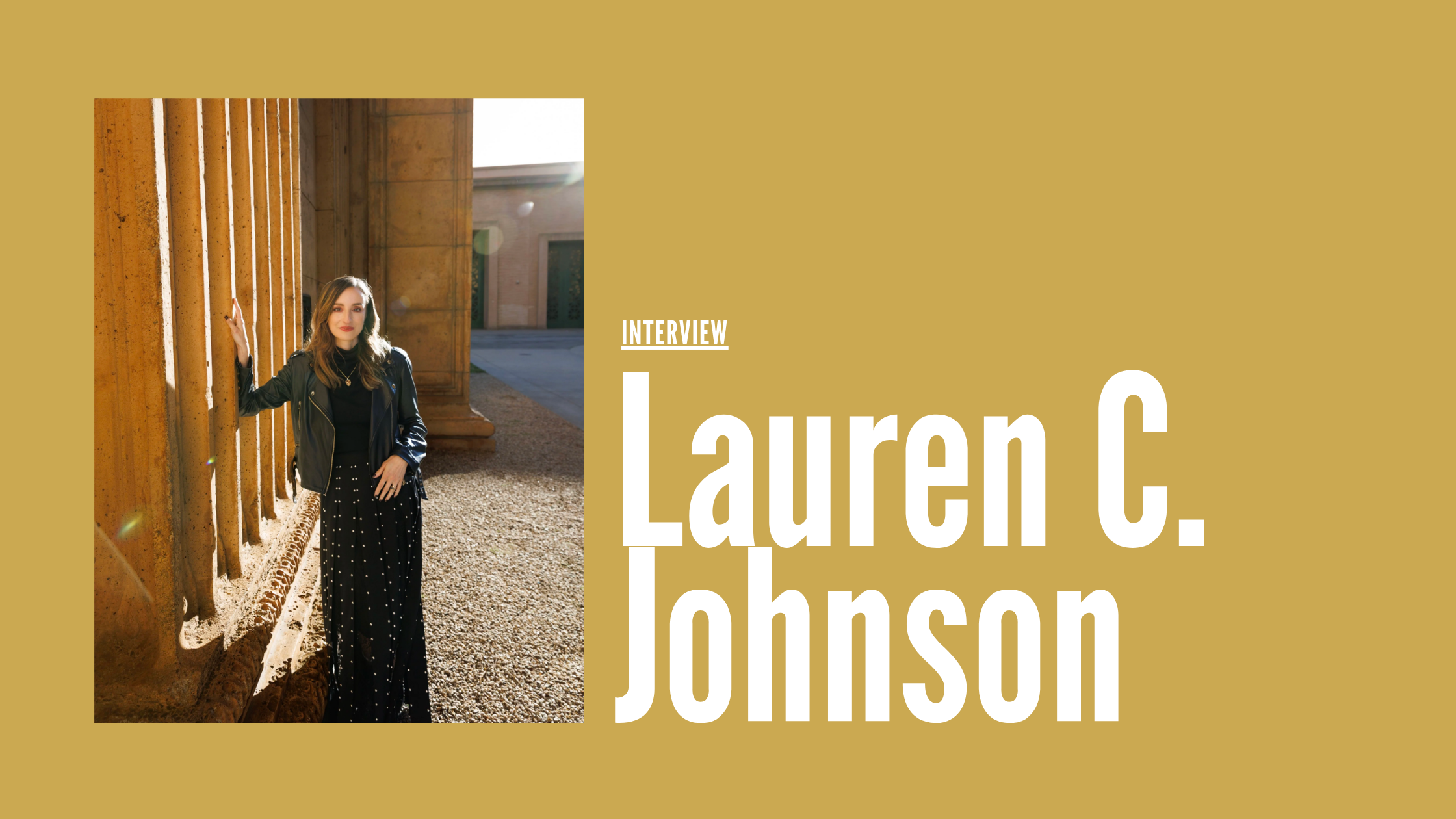
Lauren C. Johnson
Santa Fe Writers Project
A conversation with
Sarah Rose Cadorette
Lauren C. Johnson’s debut novel, The West Façade, is a luscious, heartbreaking and darkly comedic portrait of Paris at the onset of the Bubonic Plague, as seen through the eyes of an unlikely narrator: a statue on the west side of the Notre-Dame. Geneviève and her fellow statues are granted one night of movement on every new moon, but they limit themselves from leaving the cathedral grounds or indulging in any “human” desires for fear of permanently calcifying. However, when a desperate supplicant places a citrus fruit in Geneviève’s palm, she makes a decision that could render her unrecognizable to herself forever.
I chatted with Lauren about deep time, gossip, the stories we absorb about ourselves, her personal theory of divinity—and, importantly, whether her book has enough birds.
Lauren C. Johnson: Hello, oh my goodness, hi. Thank you so much for taking the time to interview me and work on this and read my book.
Sarah Rose Cadorette: Of course! I have a ton of questions for you. I'm starting with one that feels easy, because I know you—we know each other, we're friends—and I happen to know that you're obsessed with birds. I think if I didn't know that before reading the book, I probably would guess—
LCJ: So there are enough birds! I was like, “Are there not enough birds?” I mean, there's ideas of birds, but not enough physical birds.
SRC: I think there's quite a few birds.
LCJ: Okay, good.
SRC: I pulled out this line specifically: “If I had to have a deity, and if I had to give this deity a face, perhaps I wanted it to have the face of a bird.” I think that's just…the author speaking.
LCJ: That's it, yeah, for sure. I was inspired by Helen Macdonald’s H is for Hawk. Did you ever read that book? It's a beautiful memoir about—sorry, I feel like I'm diving into an answer before you've even asked a question.
SRC: Oh, my question was just, “Why are you obsessed with birds?,” so this is perfect.
LCJ: I’ve always loved birds. I remember loving them even when I was really, really little. I lived in San Francisco with my parents up until I was five, after the earthquake in ’89. We moved six months after that, because more of my family was out in Florida. I remember going to the Palace of Fine Arts and feeding the pigeons with my dad; that was our thing. I don't know if that's where the bird enthusiasm started.
As I've leaned into my fascination with birds, I've also been curious about bird lore and the role of birds across cultures. But going back to H is for Hawk, it's a beautiful memoir about how someone handled grief after the unexpected loss of their dad by training this massive goshawk, which is one of the biggest, most difficult birds you can train in falconry. In that memoir, Macdonald reflects on how, as a child, she connected with the hawk-headed Egyptian god, Horus. I was smitten with that idea.
SRC: A big theme in the book is this tension between one's carnal desires and sexuality, and the idea of temperance making someone more moral or holy. And of course, that's a big theme in Christianity, and the book centers around a Catholic cathedral, but you're not Catholic, right?
LCJ: No, I was raised pretty non-religious. My extended family are all Southern Baptists, so I think there's some overlap there, and definitely our carnal nature versus the idea of temperance is very intrinsic to all forms of Christianity.
I think most days I would, for lack of a better word, identify as an atheist, although I find a truly great sense of spirituality from our interconnectedness within our cosmos. To paraphrase Carl Sagan, the idea that we're the universe's way of knowing itself resonates with me. There are more earth-based traditions that resonate with me.
SRC: You just said something that I want to go back to—you said, “We are the universe's way of knowing itself.” What does that mean?
LCJ: I interpret that as we're constituted from all the materials that came from stars and as the universe was created, all those elements exist and are present in us, too. So we are part of the fabric of the universe, but we're sentient, so we can see and observe. I like that it positions us as part of, rather than separate from, the universe or nature.
SRC: In the book, people are not the only sentient beings. Almost everything is sentient. The walls of the Cathedral are somewhat sentient, right?
LCJ: Totally. They absolutely respond to Geneviève and the other statues. There's a magical intelligence to how the cathedral works.
SRC: The interconnectedness of everything is something that comes up over and over again in the book, and it comes up in this way where it felt like time travel or a flattening of time, because you write about Geneviève and the other statues as being the accumulation of many, many fossils, and then the ending nods to that cycle of they themselves falling into dust, and returning as whatever else in the future. Do you think this makes you a member of Antifa?
LCJ: Oh! [laughs] Antifa, believing that everything's connected—of course, yeah. I was not expecting that, but for sure.
SRC: I wanted to ask you more about that feeling of a flattening and an expansion of time that happens.
LCJ: I would say deep time was something I was thinking about. Limestone is so fascinating to me, how it comes from organic matter, and there's something beautiful about that, a kind of reincarnation. Limestone was once organic material, living, and it becomes stone, and then we end up using that stone for creating a statue or a cathedral or to build our cities with, and all the many hands that are involved and the labor involved in that—there is a deep, historical through-line that connects us to the past and also endures into the future.
That was absolutely on my mind but going deeper: what was Paris before it was Paris? Who lived there first? What was it countless years ago, and how is that history perhaps still present? For me, thinking about that is deeply comforting. Perhaps it's in the absence of religion. I think maybe I was exploring my own existential crises and through thinking of our connection to deep time, I find that interconnectedness.
SRC: Do you think that the world that we live in now, where things are not handmade very often and are highly processed, changes our relationship to deep time?
LCJ: I think it creates the illusion of feeling separate from all that came before us. We live so much in the immediate—what can we see right now on our phones, or what are these products that are being sold to us constantly—that I think we lose touch with how things are made, and actually the labor behind, for example, this computer, which is powered by rare minerals, and all the extraction and exploitation it takes to get those, and who is allowed to access that versus who isn't. If you're not the one whose land is at stake during the extraction, or you're not the one who's being forced to pull it from the earth, it's easy to forget. And I think the companies that push the next phone on us want us to not think about that. But everything has a cost. These products that we take for granted, not just technology, but mass-produced clothing as well—what is the actual human cost of that?
SRC: I saw this contention in the book between different ways of gaining knowledge. There's this idea of anamnesis, from Plato’s theory of knowledge, in which you have knowledge from previous lives, which is very different from most Western empiricist philosophers, who say that we gain knowledge through our senses and lived experiences. There's the idea that some of the statues might remember more about their past lives through their limestone beings, but then there's also Geneviève, who has this drive to experience the world and to gain knowledge through her senses and through lived experiences.
LCJ: Absolutely.
SRC: So I was interested in your perspective on whether, as humans, you think that we have some experience of both types of knowledge?
LCJ: I’ve read and heard theories that knowledge, those feelings, those experiences that are lived on and are inherited. If your ancestors were dealing with anxiety, then that might be transmitted to you as well. Ever since we're very small, we absorb messages, culture, and language, and knowledge is transmitted through language and story. So absolutely, I think our ancestors influence knowledge and perspectives to some extent. But I also think as humans, we do want to experience things for ourselves.
Rather than, “How does Geneviève obtain knowledge?,” it was more that she wants to live it for herself. It's not enough to simply be told that this is how people live, or this is what it means to be alive. I don't even know if she's trying to obtain knowledge or if she's more like, I just want to experience the world for myself, for its own sake—and I think that's important for us too, right? We can know what an outcome might be, but we're still gonna do something and fuck up, because we have to make the mistake for ourselves. We have to put our hands on the stove. That's part of being alive.
SRC: Another conduit for knowledge in this book is gossip.I was wondering what the importance of gossip was during that time in France, and what you see the role of gossip being in our lives in contemporary United States society.
LCJ: In historical records–particularly in tax documents–you can find glimpses of human behavior and traits that make you think, wow, we're not that much different than we were long, long ago. Of course, why wouldn't people gossip to share information? Gossip then can serve the same function it does now. Sometimes it's conveying important information about who's safe and who isn't, and it's kind of a network to keep other people safe, as a warning. And sometimes you just need to let off steam, like, why did this person do whatever the fuck they did? Sometimes we need a safe space to be like, “What happened, and why? And can we just process this?" Then you also reflect on, what does it say about my decisions? Especially when, for most people, communication was just through conversation, they weren't able to write, or didn't have access to writing tools, or mass distribution of any kind of written communication.SRC: I love the idea that it's keeping people safe, because that is true for a lot of modern gossip, too.
LCJ: Absolutely. I mean, look at what's going on with the Epstein files. That's one of the biggest examples, but it plays out on a much smaller scale, too. I'm hardly the first person in the literary community to talk about the role of gossip in literature.
SRC: Speaking of literature and stories—there was a line that I really loved where Geneviève says, “I was stories passed down until they became real.”
LCJ: Damn, I wrote that? That’s a good line. Thanks for pulling that out.
SRC: [laughs] Give it a Pulitzer! Anyway, so much of the book depends on the investment of the people and the statues themselves in the stories that give meaning to the statues. What do you see as being the meaning of stories in our society, where we do have unlimited access to information, factual and otherwise? Do you think the role of stories is different for us than it would have been for a society where there wasn't mass media?
LCJ: In the Middle Ages, the mass media at the time would have been distributed through the church, for example, or the University of Paris. It was theological, and there was also a law school, there was a medical school, but it was all very much part of the Catholic institution. People were deeply steeped in those stories, and building a framework and worldview around that, and then also having to decide what makes sense to me, how does this fit in with how I want to live and how I see the world? We have way more access to other types of stories now that we can build our framework around, more of a plurality of stories. We have to figure out our own compass, and we can be influenced by stories, but we have to figure that out for ourselves.
SRC: You and I share a horrible ex-boss, who told you stories about yourself that were not true. I don’t want to reveal too much, but there’s a character in the book who I wondered if they were based off of him.
LCJ: I didn't consciously base it off of him, but I think he's in there, as well as so many other people, unfortunately. There are a lot of people who want to be perceived as good and knowledgeable and as leaders, and maybe some of them really do believe that they are doing the right thing, but they're weaponizing other people's sense of naivety and shame to have an outsized influence on them.
A character like Geneviève wants to do the right thing, and they think, “I need to listen to this person because they know best, or because they have more information than me, or they're more knowledgeable than me, and I should trust this person, because everyone else does.” It goes back to those stories that we tell. If somebody in a community is a respected person, then when things start going wrong, it can be harder to trust your own instincts and own experiences about that person. We see it play out all the time in politics, and in our communities at so many different levels.
They have good ideas that you want to get behind, but sometimes in movements we think, “I like this person's politics, and I like what they're saying, but how they're actually practicing that in relation to other people is just so wrong. It's abusive and toxic.”
SRC: There’s still a hunger for power that corrupts whatever intent that they had.
LCJ: Exactly, and ego.
SRC: We were talking about this before, that the morality of the book stems from people determining their own intrinsic moral compass. And it comes from the interconnectedness of not just people, but all of the beings in the book, instead of external structures like religion. Does this make you a member of Antifa?
LCJ: Of course, absolutely. 100 percent.
To clarify, when I say we determine our own kind of moral compass, I'm not meaning it in a purely individualist, libertarian bro kind of way. It's more like, do we need an institution like the Catholic Church telling us how to behave? I want to believe that we can depend on each other, that we can aspire to good. Everything I’m about to say sounds so cheesy, but I think as humans, we can do so much good. I think that's also why I support efforts like mutual aid, because we can and should take care of each other and find that in ourselves, rather than having to rely on a church telling us there's some reward of heaven. One of the things that is part of the morality of the book is that we can and should support each other and hold each other up. And maybe that's the divinity of The West Façade.
SRC: Oh, that’s beautiful. Okay, I only have a couple more questions. Why are you in love with redheads?
LCJ: Oh, as a redhead yourself?
SRC: Yes! The representation here is amazing.
LCJ: I mean, red hair is beautiful. I had a hard time picturing what Geneviève would look like, until I saw a music video with this Turkish psychedelic funk band called Altın Gün, and the singer's name is Merve. When I saw that music video, I'm like, that's Geneviève, and this particular singer has this kind of orangey-red hair. It's also true that in the Middle Ages, some people were stupidly afraid of red hair.
SRC: So, you didn't go into this music video from the Turkish psychedelic band thinking, “Which one of these people is going to be Geneviève today?”
LCJ: Yeah, it was intuitive. It's such a cool video, it reminded me so much of The West Façade. There are people eating fruit, and people kind of lined up like statues lined up on a cathedral. It’s a funky kind of inspiration because it’s so anachronistic.. If I ever had any interaction with that singer, I'd be like, "I based a character off of you!” She'd probably think that's super creepy.
SRC: Well, I would be flattered by it.
LCJ: I think I would be, too.
SRC: Okay, I have one more question for you, and this is also a question that's in the book: If you could do anything you wanted without consequence, what would you do?
LCJ: My god, anything without consequence? The answer to that probably changes depending on the day or month. Right now, I would probably just get on a plane and fuck off, and go to Paris or Greece or something. I would love to fuel my creative practice without worrying about money or health care. I think some people would read that and say, “Well, you could do that.” But we live in an extremely expensive metropolitan area, and we have no guaranteed access to health care in the United States. So in order to survive, I just can't do that. But yeah, right now, I would just get on the plane, disappear.
SRC: Honestly, I thought you were going to tell me the list of people you would murder.
LCJ: Oh yeah, people I would murder! Maybe that's the right answer. There are some people that we all would want to murder, where there would be a collective sigh of relief.
SRC: Well, those are all of my questions! I was wondering whether I should tell you ahead of time that I was going to ask you about your personal cosmology, but you already had answers ready.
LCJ: Yeah, I feel like it's pretty baked in there. I get a little nervous talking about spirituality, because my view is informed by where I grew up, which is Western, secular, atheist. I don't want to ever talk down to other people or other beliefs.
I remember reading a whole bunch of advice columns as my dad was getting sick, like columns people had written about illness and dying. And somebody wrote to Cheryl Strayed saying, “How do I get faith in God again?,” because her two-year-old had a brain tumor. And her advice was that maybe the idea of God is something small, like your connection to other people, or the belief that if you need other people, they can keep you afloat.
We can and should turn to each other as a raft. If we have to talk about faith, maybe it can be faith in each other.