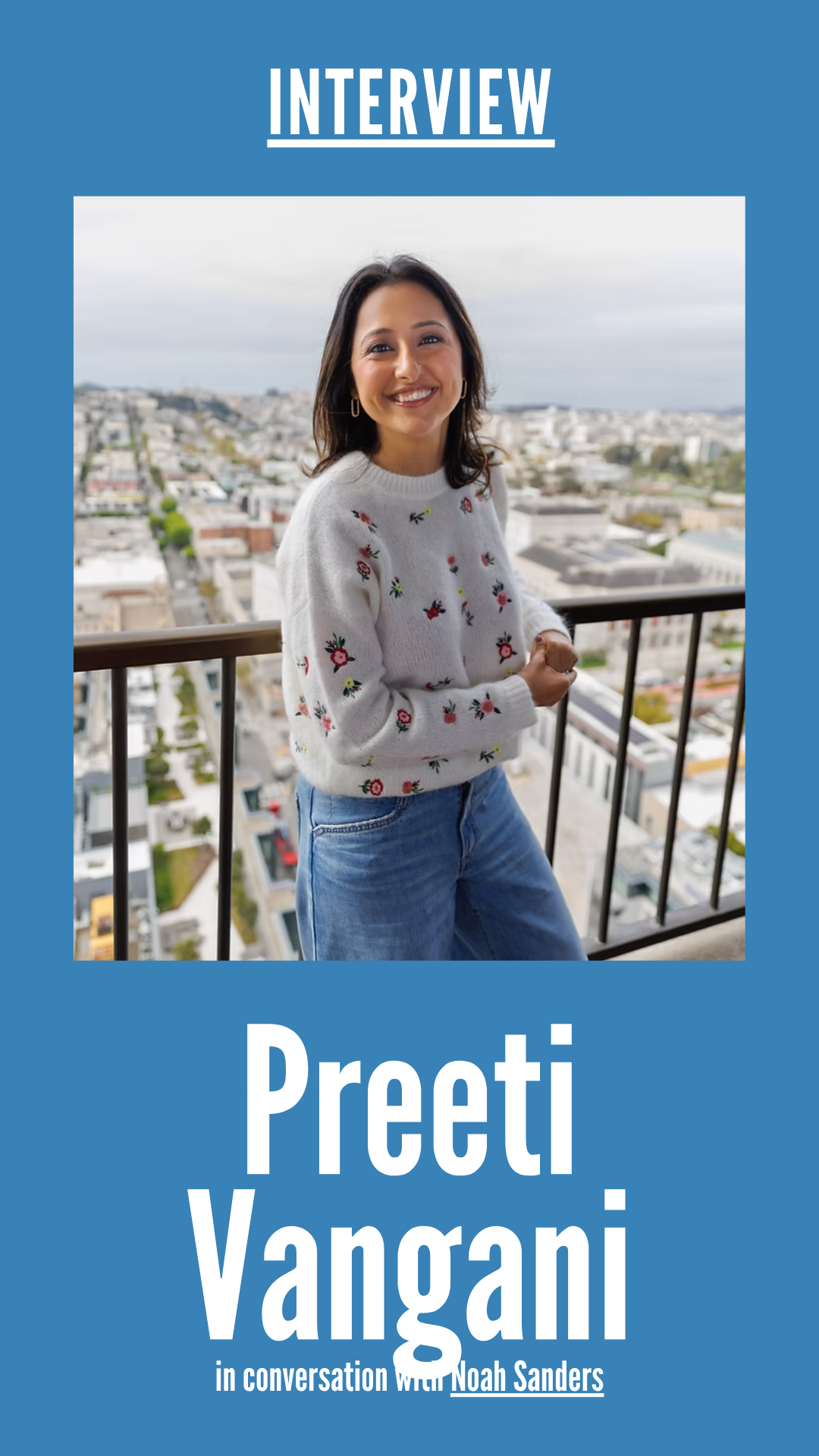
INTERVIEW: Preeti Vangani (Fifty Mothers)
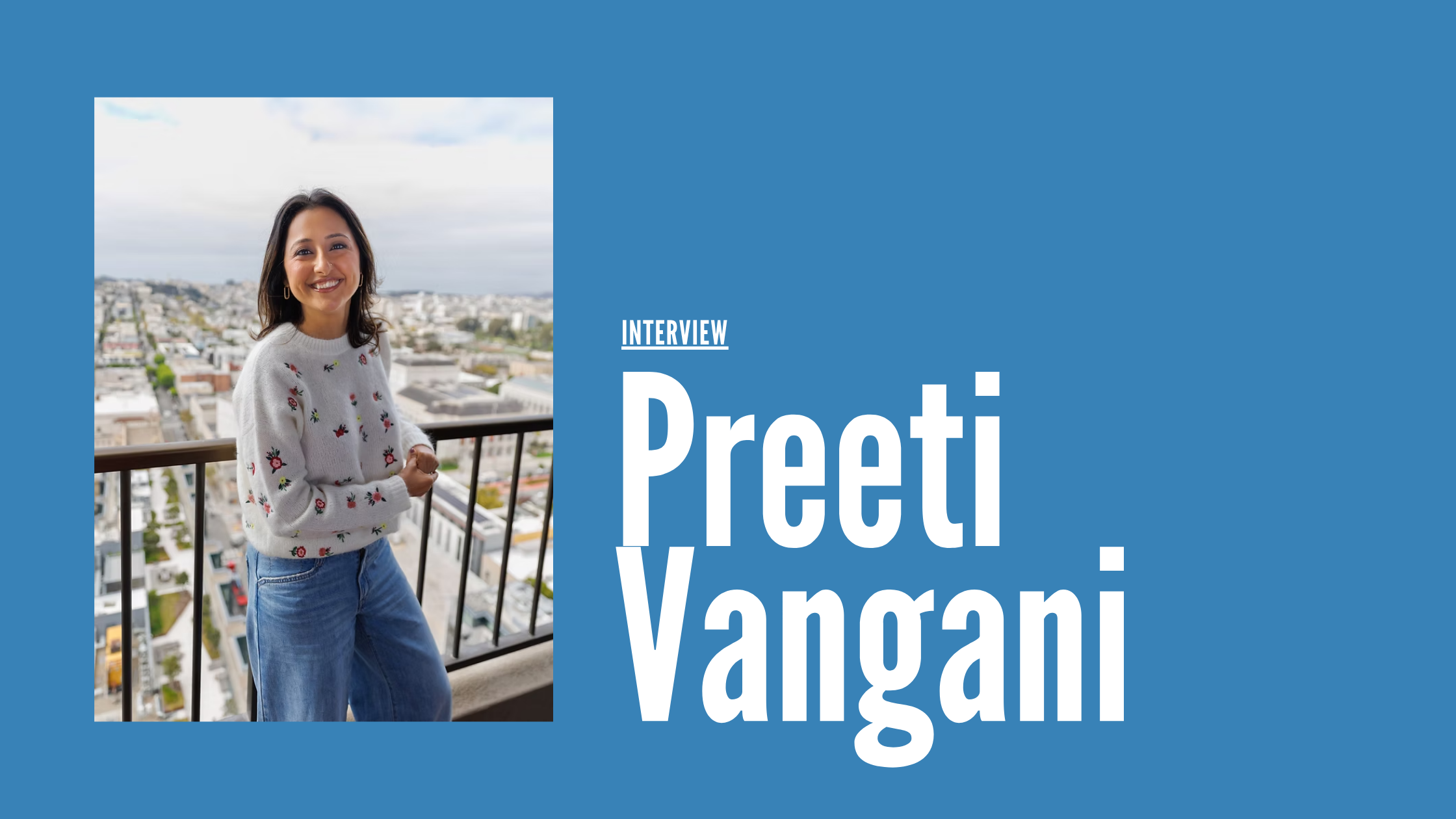
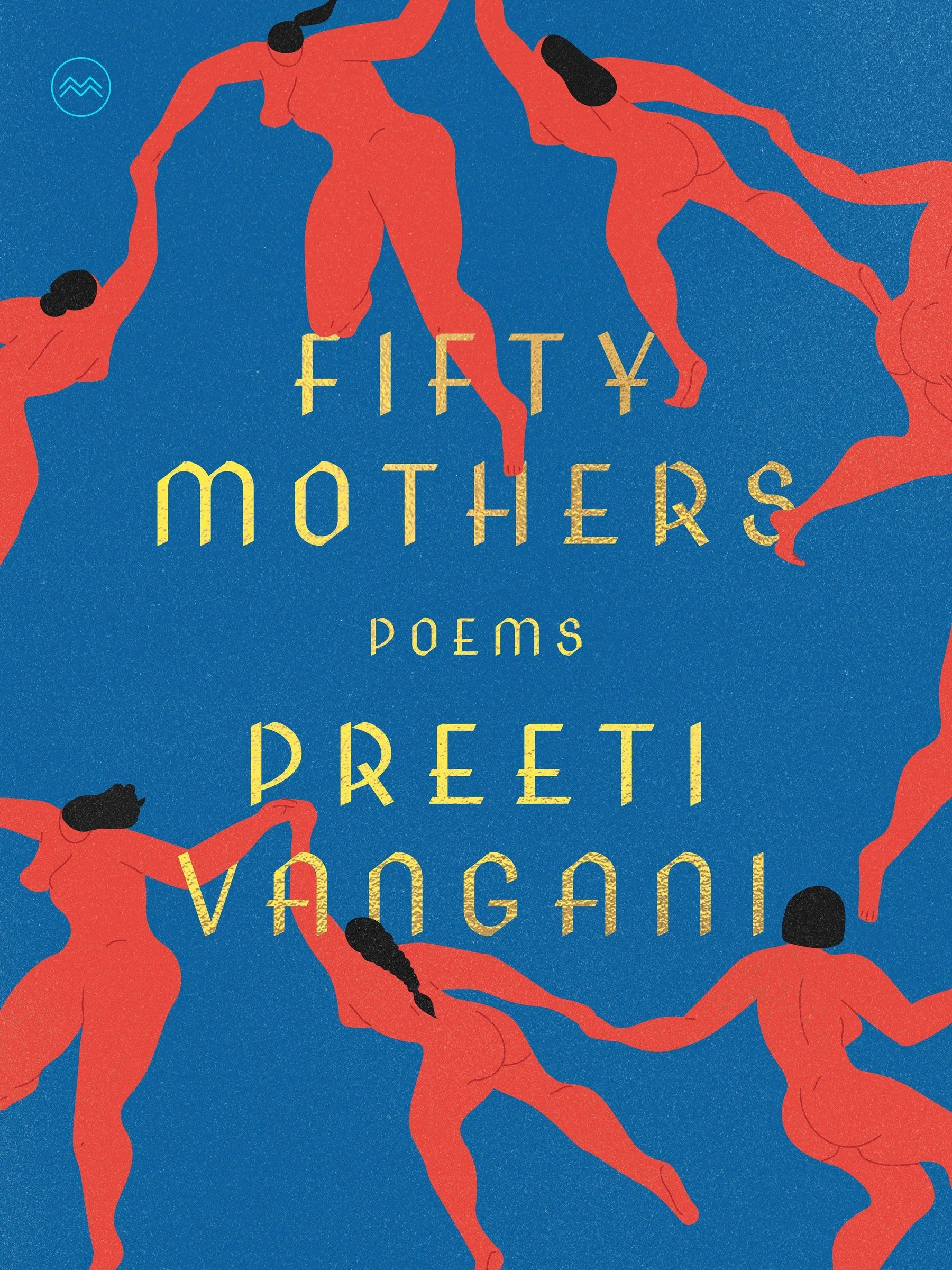
Fifty Mothers
Preeti Vangani
River River Books
A conversation with Noah Sanders
When I read Preeti Vangani’s poetry, I’m always surprised by how easily she flows between the deep sadness of loss, a coarse, laugh-out-loud humor, and raw and vulnerable sexuality. It’s a tightrope she’s been walking with great success for as long as I’ve been reading and hearing her work, and continues to do with her second collection, Fifty Mothers (River River Books).
This powerful set of poems continues to explore Vangani’s grief over the loss of her mother, but expands the scope, drawing in her father, her aunties, her lovers. In Fifty Mothers Vangani further explores the the passage of time and how her grief continues to change shape and in the process shape her.
I sat down with Vangani to talk about writing a second collection of poems, her ability to jump between tones with such grace, how teaching about writing grief has changed the way she thinks about it, and so much more.
Noah Sanders: To start — I wanted to talk about Fifty Mothers being your second collection and how the process of writing it was different than the first. Understandably, you write poems over a long period of time, so it isn't like you sit down and write one book and then another. But what felt different this time?
Preeti Vangani: My first book was literally the culmination of my MFA years. The poems often came out of prompts in class, and there was a kind of urgency and meticulousness attached to it. It was also the first time I was ever writing about the passing of my mother, so it felt like I was revisiting her death for the first time. Everything just felt like it was right under the surface, waiting to come out.
NS: Your mother passed when you were in your 20s? You're talking about grief from a very different vantage point now.
PV: Yes, I was 21. It has now been 18 years. My mother's death is now officially an adult. It’s old enough to have a beer. With the second book, that urgency went away. I wanted to hone in on what about the craft of writing poems excites me. Longer poems with a narrative impulse, poems with lists, poems with questions, poems that tactfully use comedy — these became things I noticed I enjoy the most. There was a lot more conscious storytelling, music-making, and play.
NS: Was writing one book more enjoyable than the other?
PV: They were both enjoyable in their own way. With the first project (Mother Tongue Apologize), I never imagined I'd be a poet in this form and shape, so the thrill of doing something for the first time was so freeing. I accessed a lot of my child self. But with the second book, there was the joy of thinking about accuracy and perfection in the language without losing the playful spirit. It was always about: yes, I know I can have fun — but can I have fun and make a better-sounding poem?
As I started gathering poems for Fifty Mothers, the idea of time since the traumatic event started showing itself to me. The music in my mind was different. The way I think about the characters between the first and second book is different, because that rebellious charge of leaving home in Mumbai and moving to the States has now settled into status quo — which actually allowed room for the anger and the denial to recede, and invited the question of: How was my father grieving? How were my aunts grieving? It shifted the lens for me to look at them with a love that the heat of grief didn't allow me to before.
NS: That’s what popped up immediately as I started reading: Fifty Mothers was about you and your dad, but also about you, your father and your mother's ghost, or the space your mother left.
PV: This book is about my dad. I was very clear a couple of years into writing this that it was a book for my father. And once I articulated that, all the other poems started flowing.
NS: It’s been 18 years since your mother passed. How was writing about grief different this time?
PV: I felt really tired of writing an elegy of straight-up sorrow. Somewhere along the way — maybe around the hundredth elegy — I had this feeling in my body that it doesn't do full justice to who my mother was. It doesn't do justice to the life I have now, which is filled with so much laughter. It doesn't do justice to all the times my family is together and we are bursting with abundance — jokes, hospitality, everybody has new problems. I wanted to capture the wholeness of our joy into elegy. I wanted to take anger and fear and flip it on its head. What if the lens was wonder? Which allowed me to see my father not only as this patriarchal force, but also as my friend, as a lonely man in his mid-fifties who doesn't know who he's going to share his next meal with.
NS: Why do you think sex plays such an active role in your poems?
PV: For 30 years of my life I lived in the same house with my parents. The ground rules were: You leave the house when you get married. Any time I felt at one with my body's desires, it was when I was having sex, and it had to be outside of my house. I think the body and the idea of sex keep returning in poems because I keep trying to make the distinction between the part of me that is struggling with sex as a form of rebellious happiness against the family unit, versus the part of me that actually enjoys or doesn't enjoy certain aspects of sex. What does it mean for me as a standalone person? What does it mean for me as a daughter? There is a conflict there which keeps showing itself up, and in these poems I've tried to come at that conflict—like in "The Cremation I Wasn't Able to Attend," in the direct shadow of grief, what sex and sexuality means to me now that I can get outside of that darkness.
NS: Because for so long [sex] was connected to this one structure of emotions. Now you're looking at it as: what is this normal human thing to do without any of that burden?
PV: Exactly. For a very long period of my life although I was sexually active—because my mother's death was still recent, because I still lived under the same roof—I don't think my body had the bandwidth to think about what is it about sex I actually like. And I think this book allowed me to at least start making the distinction between sex as rebellion and sex as self-love.
NS: Do you think there's a relationship between sex and grief on a larger scale?
PV: They feel connected to me at an intellectual and somatic level, because both expressing grief and having sex are acts of maximum bareness and vulnerability. In the early years after my mother passed, it really felt like an act of fulfillment. I thought of it sometimes as filling the "mother hole." Or feeling loved, because between my parents, my mother was the bigger, more expressive source of love. Being told I was beautiful, being held—there was a lot of synergy between what I had lost and what I was getting in bed. And now I feel like, as time goes on, that has stopped being the reason for writing sex into the poems.
NS: This is kind of a tangent, but you mentioned being an only child. How does writing these poems change hypothetically if you'd had a brother or sister?
PV: In the early years after my mother passed, I wished I could have been witnessed by someone else — if the exact shape of my pain could have been felt by a brother or sister. I felt incredibly lonely when nobody was there to witness the chronic conflicts between my father and me. I wished I had a sibling then. And part of me thinks the writing wouldn't even be necessary if I'd had a co-sharer of grief. So there are a lot of hypotheticals there.
NS: I love the phrase "co-sharer of grief."
PV: When I say "co-sharer," I actually think about the Urdu word हमदर्द — hamdard — which basically means an ally in sorrow or despair. When you break it down: hum is "our" or "we," and dard is "pain." I love that there is a plural manifestation of pain. That's not something you get in the English language as easily — it takes ten words to describe an ally in pain.
NS: You teach classes on writing about grief and I was interested in how writing these poems influenced how you taught those classes?
PV: I was able to build out the niche for the class I teach because I was so interested in infusing joy into grief. I was bored of writing sad poems. I was tired of hearing them. I just wanted to infuse life into the energy of grief. So I started toying around with using some elements of stand-up comedy — back-working poems I love and introducing them to people with the lens of: Look what Ross Gay is doing here. He's making a joke, because he's creating a trusting field for the tragedy that will come after that.
I wanted to extend the idea that writing about lost love or a lost parent doesn't have to be lonely. You can invite more ghosts in, you can invite sonic play, you can invite voices, desire, jokes. It's all a move towards abundance.
I’ve also found myself gravitating toward writing about food and kitchen politics. Food is a very evocative way to get people to start writing, so I started introducing that into my "Writing Through Joy" classes. Food is survival, it's history, it's memory, it's gathering — it's ripe with sensorial abundance. And even when you're most stuck — no matter how much time has passed since the grief you experienced — we eat three times a day. Food will evoke memory. It became an access point to start talking about grief.
NS: How has your writing been affected by teaching?
PV: It's been humbling to realize how many types of grief there are. Especially in the context of teaching folks of color in the Bay Area — high school students, adults, non-writers. It surprises me how death is only one kind of grief. The seasons through which I've taught this class—during the pandemic, after the pandemic, during the protests forGeorge Floyd, in the light of Asian American elders being harassed—the griefs are just percolating. Even if they're not front and center, they're around. It's been really humbling to expand my own library of understanding what community means and how we can show up for each other.
NS: When I had my son, I definitely spent six months grieving who I was before. I didn't know what it was but it was a loss. Do you think “grieving” is an overused term?
PV: I think in a social media and information-overwhelm ecosystem, it is not always used with the seriousness it deserves. Sometimes I find it used almost as vacuously as the word "community" now. But there is something to be said about the awareness of the magnitude of it, to not suppress it. Talking of leaving behind who we were, I’m turning 40 … tomorrow?
NS: Tomorrow! Welcome.
PV: [laughter] Congratulations to me. I think about the grief of not being young and being in a nightclub again. Yes. There are different magnitudes — loss of self, loss of place, exile, loss of home—but there's a kind of first-world grief that is more fleeting. You will get very temporary, almost just for microseconds, a version of your old self back as life moves on. But death is one of those finite things where this person is just not coming back.
And in this book my true and childish spirit just wanted to bring my mother back. As delusional as this is, as hopeless as this is: I am going to find ways to bring my mother back. This is why I started writing poems in my gone mother's voice—the gone mother sends a bucket list, the gone mother is telling the daughter not to mope so much. It became a way to honor her in her full humanity.
I love what the poet Gabrielle Calvocoressi says: "Which ghost are you inviting to the table?" The physical self of the gone person is not around, but the ghosts are all here. Ghosts are the engines.
NS: And what are we as writers if not people who describe ghosts? Maybe they're not ghosts that ever existed, maybe they're not people who ever passed or events that ever occurred, but we're still writing about something that only lives in a spiritual place, outside the boundaries of existence. The only way we can grasp it as writers is to turn it into something real, to put it onto a page that someone can interact with.
PV: And the fantastical, the dreamscape — these are wonderful survival mechanisms and ways to invite self-love. I lean into it.