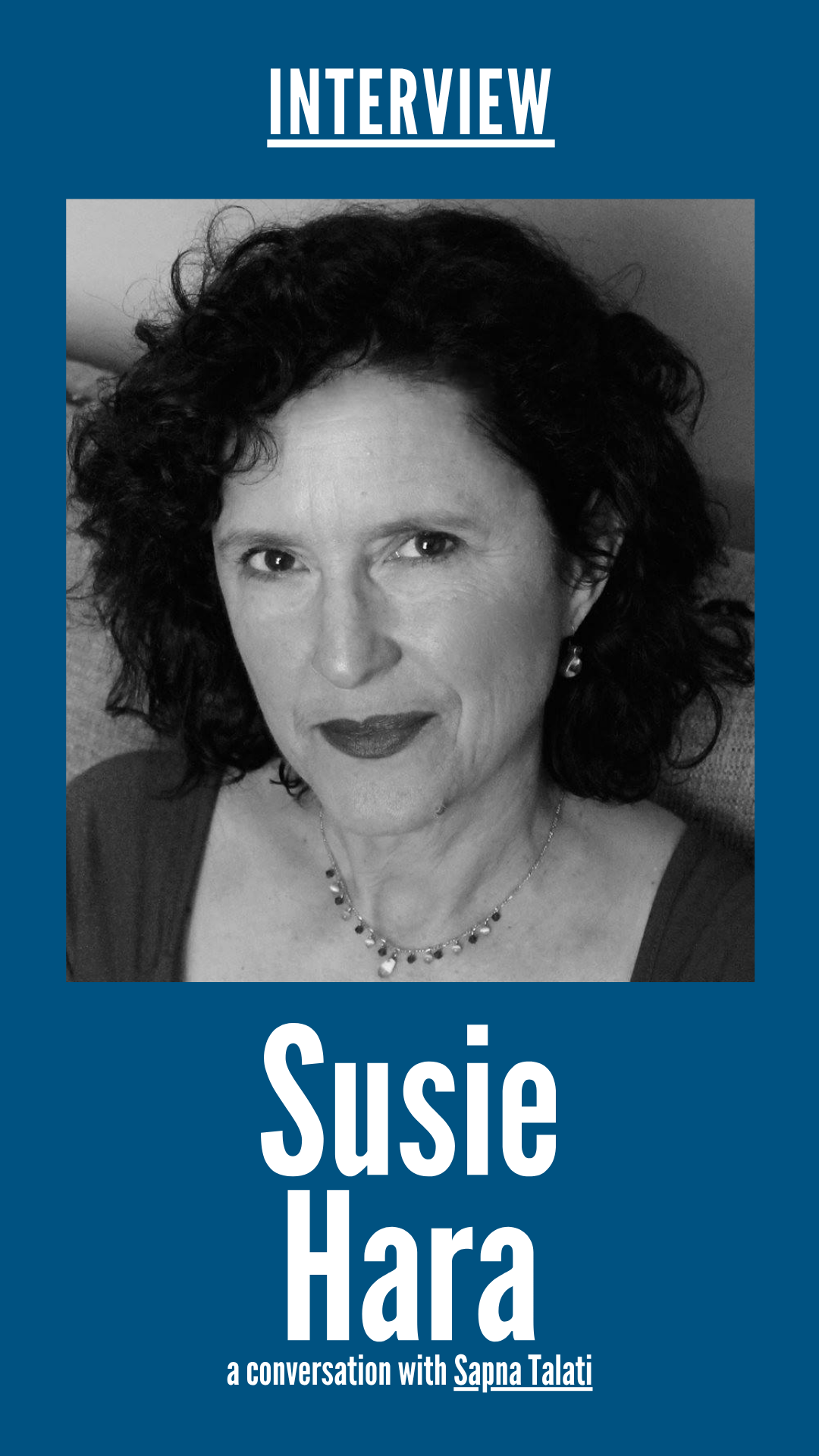
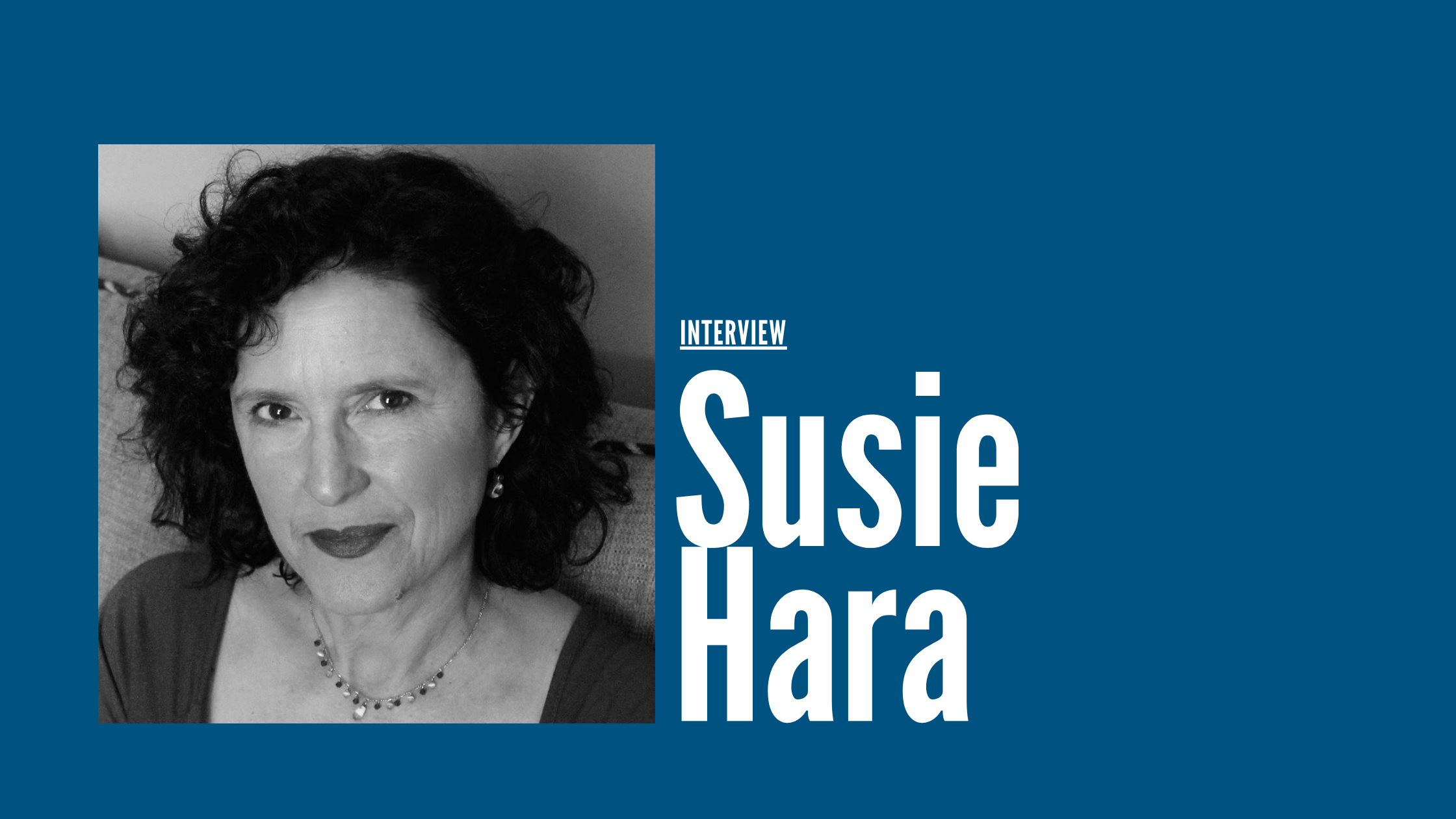
INTERVIEW: Susie Hara (Earthquake Shack)
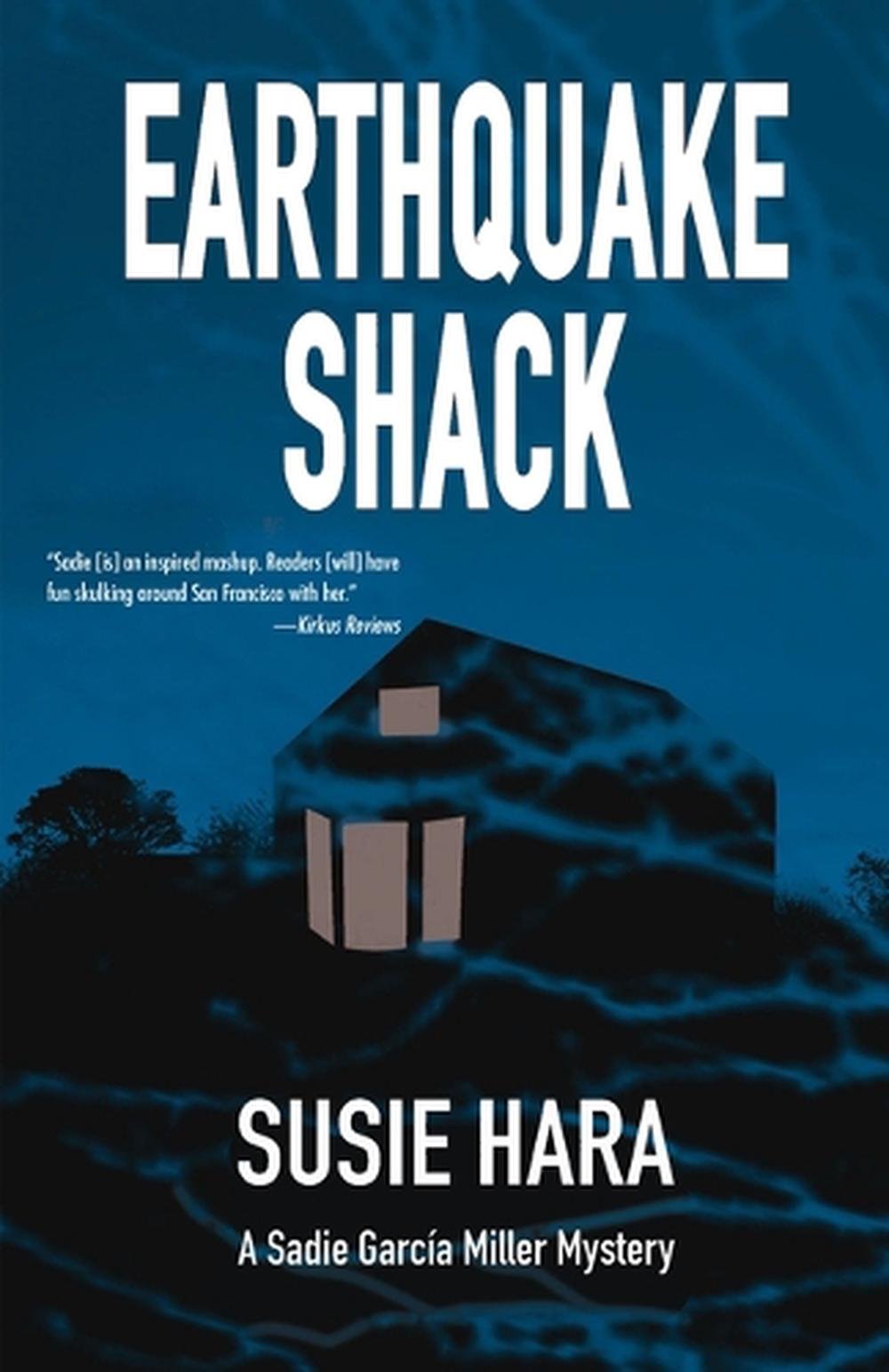
Earthquake Shack:
A Sadie García Miller Mystery
Susie Hara
A conversation with
Sapna Talati
Susie Hara’s latest book, Earthquake Shack (Arte Público Press, 2025) is a sleuthy, fast-paced San Francisco-set mystery with a refreshingly reliable narrator. Sadie García Miller is a professional finder of lost objects who is working from her Mission office when an uncle from the other side of a family rift visits not with a peace offering, but a business proposal: help the family find a missing object in exchange for a premium payment. More importantly, he offers information on her father’s mysterious death. The missing object? An entire house, which actually requires a lot more investigative work than simply driving around looking for it.
The book isn’t just a mystery, but a multicultural story of fighting social injustices, returning things to where they belonged, and a little queer romance.
I sat down with Susie Hara over a pot of tea and chatted about the book, the craft of mystery writing, and our love of San Francisco.
Sapna Talati: I have to ask before we get into it, what’s your go-to tea that gets you through writing novels?
Susie Hara: Ha, yes, that’s important! Barry’s Irish Tea or an Assam, with milk.
ST: What was the inspiration behind your latest book?
SH: This is the second book in a series. In the first book, Sadie García Miller, the protagonist, searched for a beloved missing object. For the second book, I wondered what the premise should be and what would get lost. I knew it was going to be a house and I wondered what kind of house? Why is this person so attached to it? How does a house go missing?
ST: Could you tell us a little about earthquake shacks and if people in San Francisco should be on the lookout for one?
SH: After the 1906 earthquake, there were so many unhoused people, and unlike today, the city got together and created these portable, small houses. These earthquake shacks or “relief cottages” were put up in Dolores Park and Golden Gate Park and some other places across the city. So there were thousands of people who were living in these small cottages. People living in them had the opportunity to do the rent-to-own thing, and then they could transport it somewhere. So because of that, there are still remaining houses in San Francisco that were once earthquake shacks.
ST: That’s amazing. I did check out one and was surprised it was indistinguishable from the Victorians surrounding it.
SH: That’s right. They’re not necessarily identifiable because people have restored, painted, and changed them over the years. There are a number of them in the Sunset District, and a couple in Bernal Heights and Noe Valley. There are websites so if anyone wants to see one, they can find them.
ST: Earthquake Shack isn’t just a novel about a sleuth who finds lost objects, but contains themes and descriptions of real social issues, ranging from housing affordability to the dangerous use of technology. Did you intend to write about these issues when you began your novel? Or did they emerge as you learned more about the characters and what their lives looked like?
SH: The housing issues are so present for everyone I know who lives in San Francisco. Everyone faces the stress of losing their rent-controlled apartment, or they’re priced out of the possibility of buying their own home. And of course with Earthquake Shack, an entire house is stolen. So this issue naturally emerged. And similarly, for technology, certain things just pop out of my brain and I think, okay, let me pursue this. With the crypto subplot, it wasn’t really planned but emerged as the story developed.
ST: It's like, how can you write a book about San Francisco without describing housing issues?
In a time when diversity initiatives are under attack, your novels feature a range of characters who all come from different cultural backgrounds. Can you share why you think it’s important to include diversity in novels, especially during these exclusionary times?
SH: That's a great question. For my first novel, Finder of Lost Objects, which came out 12 years ago, I was visiting a book group for their discussion of my book and one woman asked me why I made the character Latina. (Sadie is half Mexican and half Jewish, and I myself am half Jewish and half Syrian.) When I got asked that question, I just said, why not? And everybody laughed. Although I really meant it—why wouldn't I write about the world I see? It's also the world I embrace. To answer your question more directly, though, yes—we’re in a time when diversity, equity, and inclusion are under attack. The idea promoted by the right-wing, that DEI is somehow a “woke” add-on, is annoying to me, as I see inclusion that inherently has existed and should exist, not a special initiative. Also, the term woke was created in the Black community in the 1930s to mean awareness to racial discrimination from within their community. It has been completely coopted and the meaning changed, and it’s now used as a derogatory label by the current regime to mean anything they don’t agree with. Getting back to my characters, though—not only is Sadie mixed, but also her niece is Chinese and Jewish. Especially in the Bay Area, but globally too, we are all mixed—meaning our DNA comes from gene pools from various ethnicities. Some of us are also a blend of sexual orientations and genders. One of the reasons I’m compelled to write these characters is so that a reader can connect to someone of a different background or color or sexual orientation and can make themselves at home inside that person’s consciousness. That experience (I hope) breaks barriers.
ST: I loved how you laid out the clues and investigative process conducted by Sadie. Can you share with us how you plot out your clues and keep so many details organized?
SH: I’m glad you think it looks that way now because it certainly didn’t feel that way writing it. It actually felt like fumbling around in the dark.
But I do think it comes down to reverse engineering. Once I start down a particular plot line, I realize I better have some clues, but not too many that the reader can guess so quickly.
I also use a few different visual aids. I do like character mapping on paper with circles and lines, kind of like an organization chart. I’ll also do some mapping on a huge page of butcher paper. For that, I’m thinking about my characters. What do they want? How do they relate to each other?
ST: One of the other things I loved about Earthquake Shack was the feeling of running around San Francisco. I could imagine myself alongside Sadie waiting for the Muni or walking around The Mission. Can you talk about why you wanted to set Earthquake Shack here? What is your personal connection to San Francisco?
SH: I love San Francisco. I've lived here for over 40 years. And I've mostly lived in or near The Mission. For 17 years, I lived a few blocks away from where I set Sadie's office. Her office is on Valencia near 26th. It's a real building, and when I walk by, I’m like, oh, that's Sadie's office; it's very real to me. I pointed it out to someone once, that’s where her office is, and they asked me if Sadie was a real person. I was like, well no, but in my head, she’s real.
ST: Earthquake Shack is your third mystery novel. What drives you to write mysteries?
SH: For my first novel, the first in the Sadie García Miller series, I thought I was writing general or literary fiction. But when a developmental editor read the draft, she said, you know, this reads like a mystery, and she advised me to consider making it more of a mystery. So I did. Then, for my second novel, The House on Ashbury Street, which is a stand-alone book, it’s literary fiction, a character-driven story, but there is a sort of mystery woven through it, a death and the characters’ journey to understand it. So with that novel, I didn’t think of it as mystery per se but one of the people who blurbed the book called it a literary mystery anyway!
ST: So you didn’t intend to necessarily write mystery but that’s where your creative side naturally went.
SH: You know writers can either be plotters or pantsers (writing by the seat of their pants), and I am definitely more of a pantser—I write intuitively. So I didn’t realize I was writing mystery and then I was like, oh, I guess this is where I am going.
And I like the feeling of being propelled and escaping my world to have to puzzle it out, figure something out. I had been reading mysteries for many years when I started writing fiction, so I think they were just all in there, in my consciousness. I also like the idea of writing the book you would love to read.
ST: I think that's great advice for authors. Just write the book you want to read. So if I may ask, who are some of your favorite mystery authors?
SH: I'll try to narrow it down; there are so many. My favorite mystery writer is Kate Atkinson—her Jackson Brodie novels. Her writing is so beautiful and her characters are so unexpected and quirky. I also am a fan of the authors Sue Grafton, Marcia Muller, and Sarah Paretsky, who were kind of the matriarchs of the woman sleuth detective novel. I also am a fan of Louise Penny and Donna Leon.
ST: I attended your book launch at Book Passage in San Francisco last October and learned that your husband is a real private investigator. So I have to ask, what is it like being married to a private investigator?
SH: Well, I have gotten some tips from him, definitely. Not for the whole manuscript but for certain passages, like if a scene involves surveillance or a stakeout, or if someone is creeping around trying to find out information. I can also share that my husband was the inspiration behind Sadie’s regular boxing workout. So I have borrowed certain things from him and sometimes I’ll ask him to look over a particular scene.
ST: Does he ever need help finding things in your home?
SH: Absolutely. And occasionally, he finds things for me. But generally, I am the expert. Actually my mother used to say I was good at finding things for her when I was a kid.
ST: That’s a unique talent. Do you think this has shaped your writing and the way you observe the world?
SH: It did somewhat spark the idea of this series, because each book is centered on Sadie finding a beloved missing object. As far as this skill shaping my writing and the way I observe the world, the connection there is intuition. Sadie uses her intuition to find the lost object. And I am an intuitive writer, what some call a “pantser” (seat-of-the-pants writing). I don’t have an outline, but I start with an idea or scene that is sparked by something that comes to me intuitively. I go where the characters take me, often to surprising places!
ST: If you don't mind sharing with us, will there be a third Sadie Garcia Miller mystery one day?
SH: Yes, book 3 is in progress—I have a first draft. I should say a rough draft! As I’ve done with the drafts for my other books, I asked a trusted freelance editor for a big-picture manuscript assessment. But even with her feedback and with taking my time to read it through and start the process of revision, I’m struggling with this draft more than I have with my three previous books. I’m finding that what I’ve done in the past—reading over the manuscript and flagging issues and fixing what doesn’t work, from a craft perspective—isn’t working. It feels like the novel is off track. I’ve already cut big chunks and am looking at what might take their place to get back on track. Trying to reimagine the story. Persisting. The writing process—it’s a matter of keeping the faith, right? But I will share the working title: Missing Rubí.